
I knew nothing about these creatures until we bought our house in France. I can’t remember when we first became aware of their existence, probably after the arrival of Zeph. Neither can I remember exactly when we spotted their nests in two of our large pine trees. I’ve searched through our many photos of the garden, but can’t find any images of the nests.
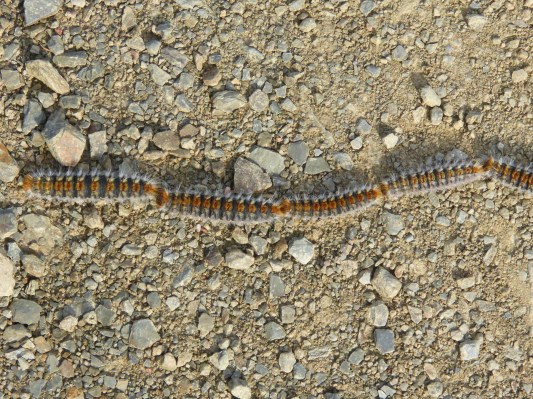
The pine processionary caterpillar is found in large areas of France, particularly in the south. However, with climate change, they have been appearing further north, as well. The more I find out about them, the more worrying they become, especially as a dog owner.
The caterpillars are dangerous to dogs and humans because they have thousands of microscopic hairs, which can cause severe allergic reactions. In humans, these include major skin irritation and breathing issues, but in dogs, licking the caterpillars can lead to necrosis of the tongue, which can be fatal.
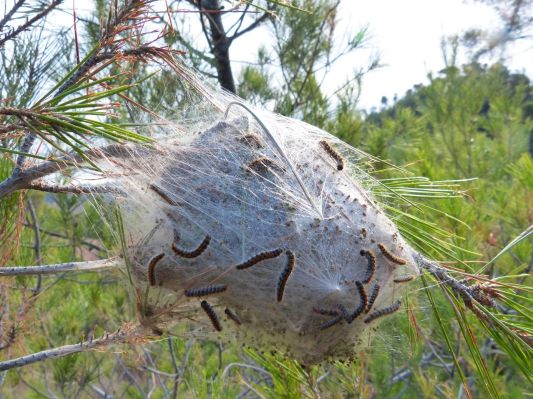
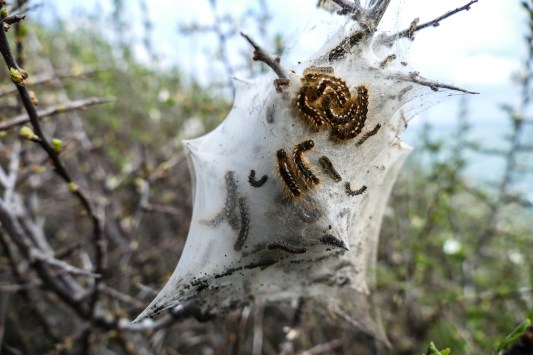
The moths of the processionary caterpillar are unremarkable, small and greyish brown. They are nocturnal, normally only alive for one night. Their eggs are laid in summer, and the nests resemble white silk cocoons. It was when we first noticed these that we began our enquiries into what they might be.
The nests can contain hundreds of caterpillars, which descend to the ground from January to May, depending on the weather. This is when they make their long nose-to-tail processions, as they search for a place in the earth to pupate. Not only are they a threat to people and animals, but the caterpillars feed on pine needles, thereby weakening or compromising the host tree.
There are some natural predators, such as Crested tits, that eat the eggs and young caterpillars. Cuckoos also eat the caterpillars, and Hoopoes the pupa. Bats eat the moths, but this has little overall impact. So, how do you get rid of these unwelcome visitors? There are some traps available for purchase, but the overriding advice is to employ a professional.
As luck would have it, Dan, who looks after the house and garden in our absence, is a qualified tree surgeon with extensive and practical knowledge to sort out our tree-related problems. As we have been advised to have the nests and trees removed before we put our house on the market, this has taken place in our absence.
We are due to return to France shortly, and I will be relieved that this issue has been sorted. The further I have researched into pine processionary caterpillars, the more relieved I am that this threat to Zeph, in particular, has been removed.

Discover more from Fancying France
Subscribe to get the latest posts sent to your email.

 Fancying France
Hi June, another interesting post. Great! Crikey, they are weird looking things, aren’t they? Looks like lots of little ones joined together 😄 xxx
LikeLiked by 1 person
Thanks, Joey. Yes, that’s exactly what they are 😂😘
LikeLiked by 1 person
WE also have a lot of processionary caterpillars her. It is good to know the crested tits eat them as the tits have made a nest in our bird box.
LikeLiked by 1 person
They seem to be spreading far and wide! We have hoopoes in our garden, but a bird box is a great idea.
LikeLiked by 1 person
How perceptive of me 🤣 😘
LikeLiked by 1 person
indeed! 😘
LikeLiked by 1 person
What an interesting and unlikely post. I am a friend of Hugh’s and am just out visiting the blogs he recommends on his site. Thanks for sharing. I hope you got your problem solved. 🙂
LikeLiked by 1 person
Hello Marsha! Thanks for visiting my blog, and I’ll definitely return the compliment. I love Hugh’s blog and find his blogging tips particularly useful. We’ve just returned to France, and I’m glad to say those pesky caterpillars have been removed!
LikeLiked by 1 person
So glad to hear it. That was a bit squirmy! 🙂 xxx
LikeLiked by 1 person
My friends’ cat once got very sick when she encountered these caterpillars (they live near Toulouse). It was interesting to learn more about these insects – thanks for the info, June (and stay safe, Zeph!)
LikeLiked by 1 person
How awful for your friend’s cat, I hope she made a full recovery. We’re now back in France, and the caterpillars have been removed. Thanks for your comment, Darlene.
LikeLiked by 1 person
My goodness new to me, that these caterpillars are dangerous to dogs and humans – ugh!
LikeLiked by 1 person
Exactly – ugh! We’re now back in France, and I’m pleased to report that the caterpillars have now been removed. Thanks for your comment.
LikeLike
Now the first photo looks cute and I’d want to investigate. The 2nd photo would have me staying well away. I hope everything was sorted for you in time for your visit. Thanks for joining in with #pocolo
LikeLike
These caterpillars are very nasty. When I was researching this post, I came across some photos of dogs who had licked these creatures – still traumatised now! By the time we got back to France, everything had been sorted, which was a relief. Always enjoy #pocolo
LikeLike